
When a retailer like Marks & Spencer or an automotive manufacturer like Jaguar Land Rover suffers a cyber attack, the primary pain is commercial. Systems go offline, production lines pause, and revenue slips away. It is painful, but the impact is largely contained within financial spreadsheets and customer inconvenience.
For critical national infrastructure, the stakes are fundamentally different. A major incident in the energy sector does not just threaten quarterly earnings; it risks turning off power to hospitals, water treatment plants, and millions of homes.
Prevention to Resilience
In response, regulators are increasing the pressure and shifting the mandate. Instead of focusing solely on preventing a single attack, they are asking a much harder question: Can your systems withstand and recover from advanced threats without interrupting essential services?
This regulatory drive forces energy providers to treat resilience as a core operational discipline.
Over the past two years, Cydea partnered with a primary UK electricity distributor to transform their approach. Using a risk-led approach, we identified high priority focus areas and aligned their practices with the Cyber Assessment Framework (CAF) Enhanced Profile.
Cydea helped this organisation to:
- Achieve framework alignment: Produced 56 comprehensive policies aligned with over 2,500 legal, regulatory, and framework requirements,
- Define operational structure: developing an operating model to capture proposed capabilities,
- Unlock investment: directly contributed to the client securing an eight-figure investment to implement their security improvement plans.
Read more about our case study here
Why quantification can be a benefit
Cyber investment is often viewed as tax, where senior leadership fail to see the true return on investment provided by the controls / mitigations put in place to protect our energy supply.
Cyber risk quantification changes this dynamic by translating abstract threat scenarios into financial terms. By leveraging probability distributions and risk-modeling methods used in the financial sector for years, quantification eliminates the endless debate over what a subjective “red” risk actually means.
Instead, it empowers decision-makers with real numbers, allowing them to compare tangible costs, like equipment replacement and NIS2 fines, directly against their cybersecurity investments. Think of it as building a watertight business case backed by your potential operational losses versus the cost of your security programme.
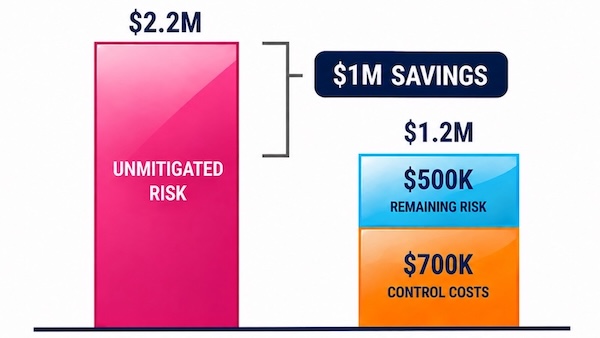
By adopting our risk & cost based approach, we’ve identified a clear opportunity to save $1 million. Presenting analysis in this way is valuable when defending your security spend."
What is inside our pack?
To help energy CTOs/CISOs quickly quantify their key security risk scenarios, we have developed an Energy-specific Risk Pack. Our consultants have used our range of industry experience and tailored these scenarios to save you tens of hours on research, it provides pre-configured, data-backed threat scenarios including:
Remote Access Compromise (Disruption of operations through remote access system compromise)
- Why it matters: Intruders exploit remote connections to disrupt power generation, causing expensive downtime.
- Why quantify it: It weighs equipment replacement costs against potential NIS2 fines (up to 2% of global turnover) to justify security budgets.
Supply Chain Disruption (Supply Chain compromise disrupts operations)
- Why it matters: A security breach at a critical supplier or vendor can shut down physical operations.
- Why quantify it: It calculates daily contract penalties (up to 35% of power revenues) to optimize backup supplier terms.
OT Malware Infection (Industrial Control system infected with Malware/Ransomware)
- Why it matters: Viruses spreading from office computers to OT systems can halt power distribution.
- Why quantify it: It compares specialist cleanup costs (£260 to £410/hr) against recovery testing to optimize response budgets.
Vulnerability Exploitation (Exploitation of software vulnerabilities in third party devices)
- Why it matters: Flaws in third-party software can let attackers run energy devices outside safe limits.
- Why quantify it: It translates outages into compliance penalties and customer credits to guide patching priorities.
Grid Telemetry Tampering (Unable to trust systems reporting on state of grid)
- Why it matters: If operators cannot trust control-room data, they must run the grid manually, creating safety risks.
- Why quantify it: It models potential lawsuit and legal defense costs to justify investments in data integrity.
Take action: 3 steps to defend your operations and budget
Moving from subjective matrices to defensible metrics gives leadership true clarity. Here are three actionable steps to get started:
- Know your estate: You can’t defend what you don’t know about, ensure you uncover all relevant systems that directly or indirectly support keeping the lights on.
- Quantify high-impact scenarios: Use our Energy Risk Pack to translate potential operational outages into hard financial loss bounds.
- Empower leadership with data: Present these quantified scenarios against the cost of your proposed security program to justify your spend.
Transitioning to a quantified risk approach doesn’t have to be overwhelming. Contact the Cydea team today to discover how we can help you implement this playbook and protect your critical mission.
Photo by Quentin Grignet on Unsplash


 Niall McElroy
 Priya Deuchande
 Iris Compañ Del Monte
 Lucia Turner
 Robin Oldham