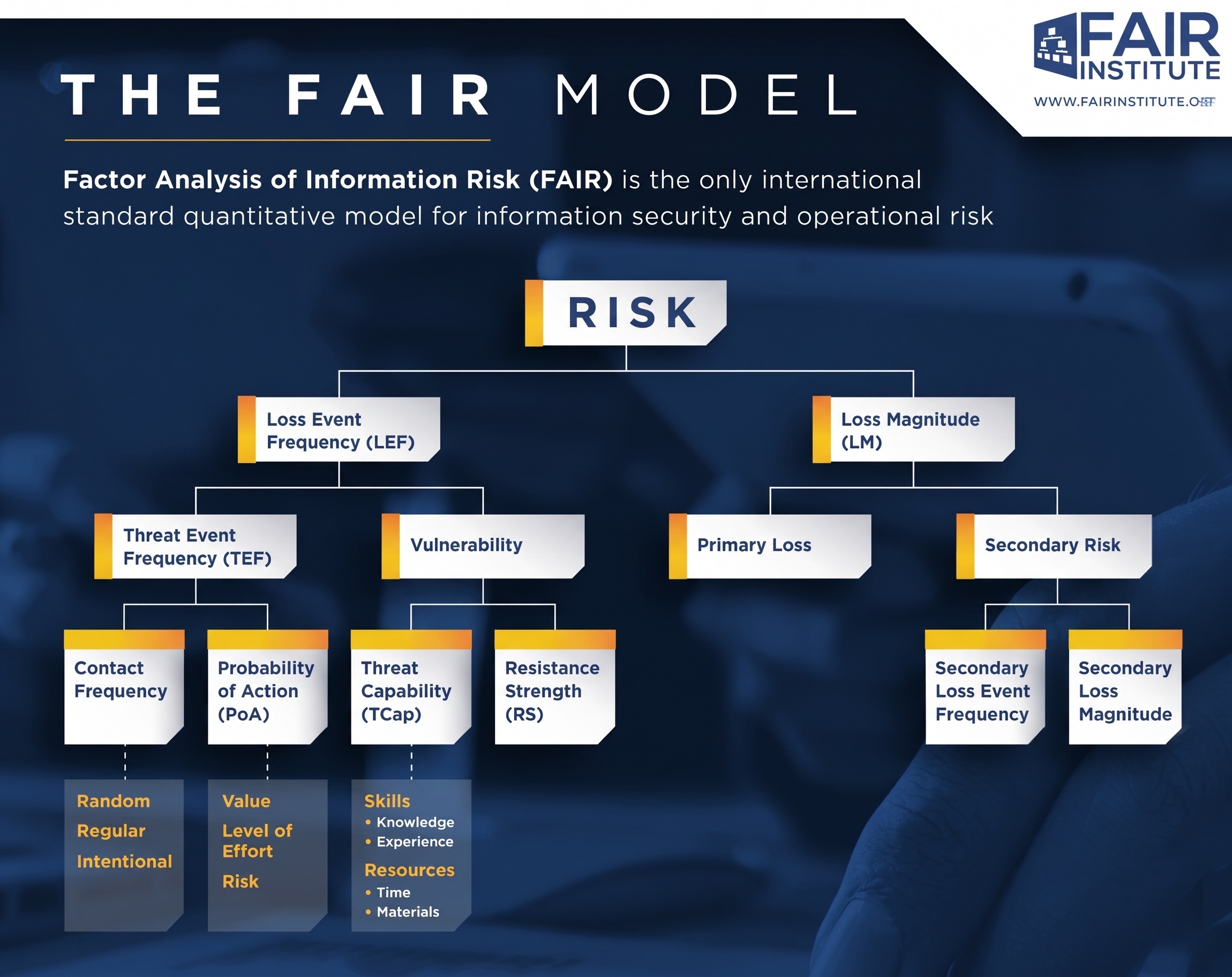
Factor analysis of information risk (FAIR) is a risk analysis model which considers bottom-up factors, particularly vulnerabilities, to determine cyber risk in financial terms.
Bottom-up, technical cyber risk assessment is about working out what specific events and actions can cause a breach. However, this can rely on qualitative approaches which can lead to arbitrary assessment and treatment decisions. FAIR tries to avoid this by computing real-world probabilities and impacts from underlying factors, such as contact frequency, threat capability, and resistance strength.
‘Contact frequency’ is how often a threat actor tries to compromise organisational systems, ‘threat capability’ is how capable this actor is at attacks, and ‘resistance strength’ represents the controls an organisation has to prevent attacks.
There is merit in this. In statistics, factor analysis is the process used to work out what underlying independent factors drive changes in an observed outcome. Equally, presenting cyber risks in financial terms allows like-for-like comparison for risk remediation with other investments a business might want to make.
 Credit: FAIR Institute
FAIR recognises that the best way to present risk in most organisations is in financial terms to allow direct comparison with operational risks and other candidates for investment.
Ultimately, many business activities involve taking risks in the hope of return on investment, whether those risks are calculated or not. Without understanding risks in financial terms, cyber security risk management decisions cannot be weighed against other investments which may explicitly promise a defined amount of cost saving or improved revenue.
The benefits and drawbacks of FAIR
The key benefit of FAIR is that it allows technically mature organizations to realise further business value from their technical security data.
The key drawback of FAIR is that, to be effective, it requires a lot of that same technical data from across an organisation’s estate, and it also requires effective threat intelligence. In other words, it only works for organisations with quite mature security programmes.
Because of how it is structured, FAIR requires a very large amount of data to be processed for a large number of hypothetical technical risk events. Even with the correct data, error handling can cause issues. As an artificial sidestep, some of these factors are decided qualitatively on discrete scales.
As you attempt to make multiple different estimations about each of the different factors, such as contact frequency, threat capability, and resistance strength, estimation errors multiply.
If you do not include error bars in your estimations for each of these factors, it’s impossible to say how precise your estimate is or what caveats exist to your estimates.
Basing quantitative risk factors on qualitative underlying factors also leads to arbitrary conclusions. Quantising factors in this way increases the error bars on the result; not only are you rounding technical data into a convenient box, but some element of arbitrary judgement is necessary; perhaps 4 or 5 times for each risk.
The outcome is that the process is labour intensive and can produce arbitrary outcomes which do not, by default, capture the uncertainty in the data.
Managing uncertainty with confidence intervals
Top-down quantitative estimation using confidence intervals builds in error bars of a single factor as a feature rather than a bug and means you must only estimate one factor for the impact of a scenario.
If you’re uncertain about something, you need to capture that uncertainty in your decision-making process. This is what estimating confidence intervals allows you to do. Estimating a single confidence interval for a given impact allows simple uncertainty handling of one error bar per scenario, and building uncertainty handling into risk analysis as a central component rather than as an inconvenience.
FAIR’s focus on technological factors can lead to over-emphasis on technical risks with little consideration for organisational results.
By focusing on technical factors, the FAIR methodology can distract decision makers from what matters most: pursuit of organisational objectives and prioritising improvements to protect these. This means that, often, FAIR may fail to realise its greatest benefit: cyber risk expressed in business risk terms.
“There are many cases where people have tried and failed to get the value.” — Director discussing FAIR implementation
Taking a top-down approach
For many organisations, there are alternative approaches.
Without deep technical analysis, expensive expertise and time-consuming data collection, the benefits of FAIR can be hard to realise. There is a more straightforward approach which allows you to prioritise risks for remediation in financial terms.
At Cydea, we take a top-down approach.
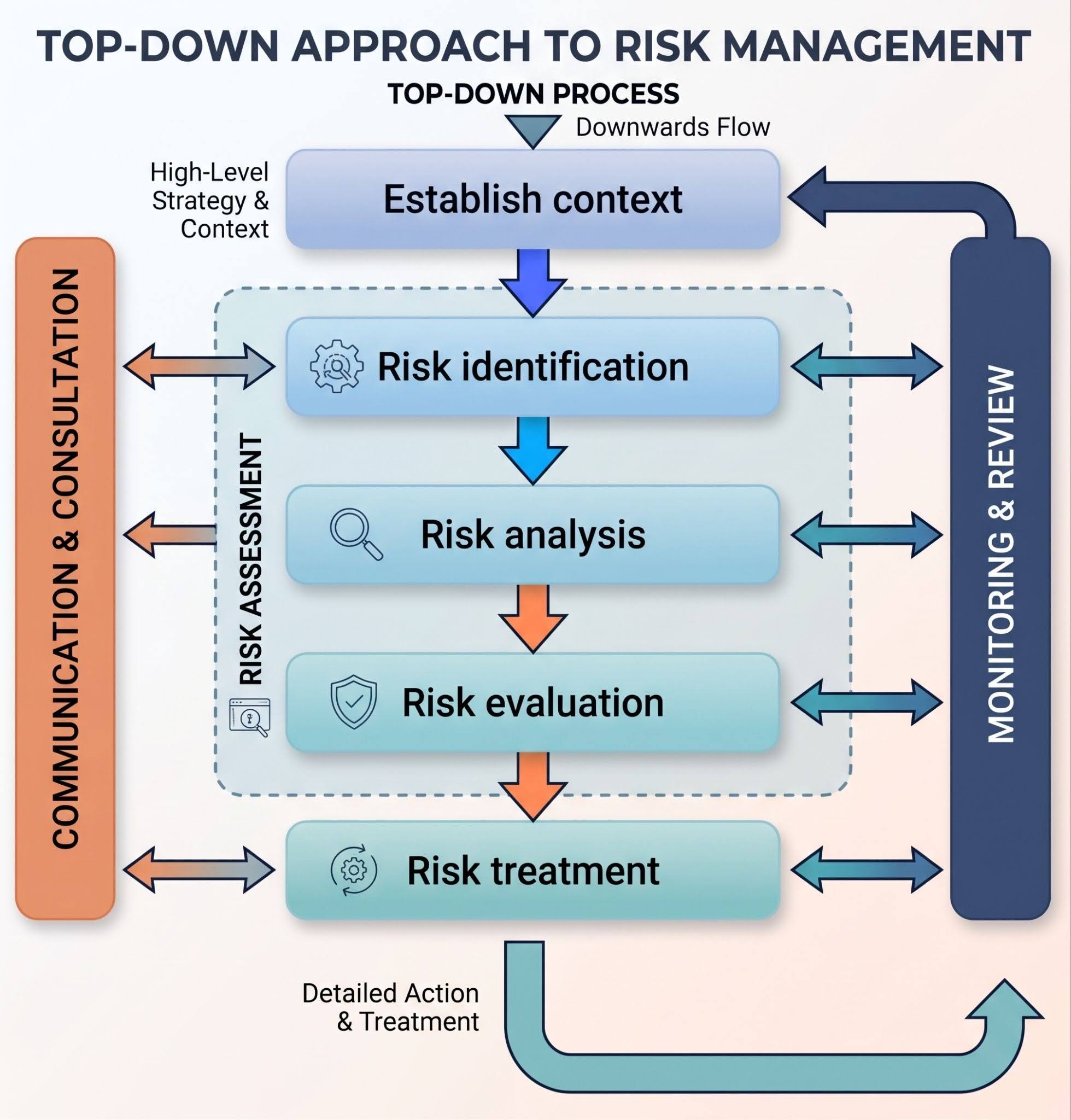
This means beginning by identifying organisational objectives, how these depend on information systems, and then determining how security events could disrupt these systems. This allows risks to be aligned closely to business objectives without requiring huge swathes of technical data. Building an understanding of frequencies and impacts of different risks based on both experience and broad data sets from across industries provides reliable estimates. These represent potential impacts as distributions of monetary values rather than fixed averages or qualitative boxes.
The top-down approach:
- Embraces uncertainty as a fact of life rather than an inconvenient truth to be swept under the carpet;
- Focuses on business value, first and foremost;
- Models ‘everyday’ incidents alongside more serious ones.
If you’d like to get started taking a top-down approach to cyber risk quantification, start your free trial today, jump in and explore!
Photo by Charlie Wollborg on Unsplash



 Priya Deuchande

 Iris Compañ Del Monte

 Ray Morrison

 Lucia Turner